Music WeekMauritius 2026
Day 2Monday · 16 June 2026

Basic Music Workshops

The day Music Week opens its doors to absolute beginners — six parallel workshops covering voice, guitar, piano, percussion, song-form and ear training, all taught by our showcase mentors.

Format
6 open workshops
Level
Absolute beginner welcome
Faculty
Showcase mentors
Streaming
Recap on NOUZIK
Today's narrative

The story of Day 2.

Day 2 is the day the festival becomes a school. The big stages from yesterday are quiet — instead, six small rooms run all day, each one led by one of the artists you'll see on Day 7. The deal is simple: walk in with no experience, walk out able to do one thing you couldn't do this morning.

Mornings are technical and individual — voice production with Stacy Laville, first chords on guitar with Damien Pontil, the piano keyboard demystified by Mélanie Amboule, and the ravanne / hand-percussion fundamentals taught by Salem and Rémi Beaugendre. After a Creole lunch in the courtyard, the afternoon turns collective: a song-form & ear-training clinic led by Jamel, and a Madagascar-to-Mauritius harmony lab with Félicia & Théo where the whole room sings as one voice.

The day closes with an open-mic "first take" — anyone who attended a workshop can step up, even if it's their first ever public sound. The crowd is on your side.

Full Schedule

From morning workshops to the late-night set.

  1. 09:00

    Vocals 101 — finding your honest voice

    Conservatoire de Musique · Studio A

    Posture, breath support, warm-ups, head vs chest voice, and singing a phrase you actually like. Led by Stacy Laville.

  2. 09:00

    First chords on the guitar

    Conservatoire de Musique · Studio B

    Holding the instrument, tuning, the four chords that play half of pop music (G · D · Em · C), and your first strumming pattern. Instruments provided. Led by Damien Pontil.

  3. 11:00

    The piano keyboard, demystified

    Conservatoire · Studio C

    Where the notes live, the shape of a major and minor chord, and playing a song with two hands by lunchtime. Led by Mélanie Amboule.

  4. 11:00

    Ravanne & hand-percussion fundamentals

    Conservatoire · Outdoor pavilion

    Holding the drum, the basic séga tipik pulse, call-and-response, and locking with another player. Led by Salem and Rémi Beaugendre.

  5. 13:00

    Creole lunch + instrument petting zoo

    Conservatoire courtyard

    Free lunch, every instrument from the day laid out on a table — try anything, no judgement.

  6. 14:30

    Song-form & ear training clinic

    Conservatoire · Hall

    How songs are actually built: verse, chorus, bridge. Hearing chord changes. Writing your first 8-bar hook. Led by Jamel.

  7. 16:30

    Harmony lab — Madagascar meets Mauritius

    Conservatoire · Hall

    Two- and three-part vocal harmony exercises drawn from Malagasy and séga traditions. The room becomes one choir. Led by Félicia & Théo.

  8. 18:30

    "First Take" Open Mic

    Conservatoire · Hall

    One song each, any instrument, any level. The mentors stay in the room and clap loudest.

Six rooms, one philosophy

Every workshop assumes you've never done this before. Every workshop ends with you actually playing something. No theory without sound, no sound without context.
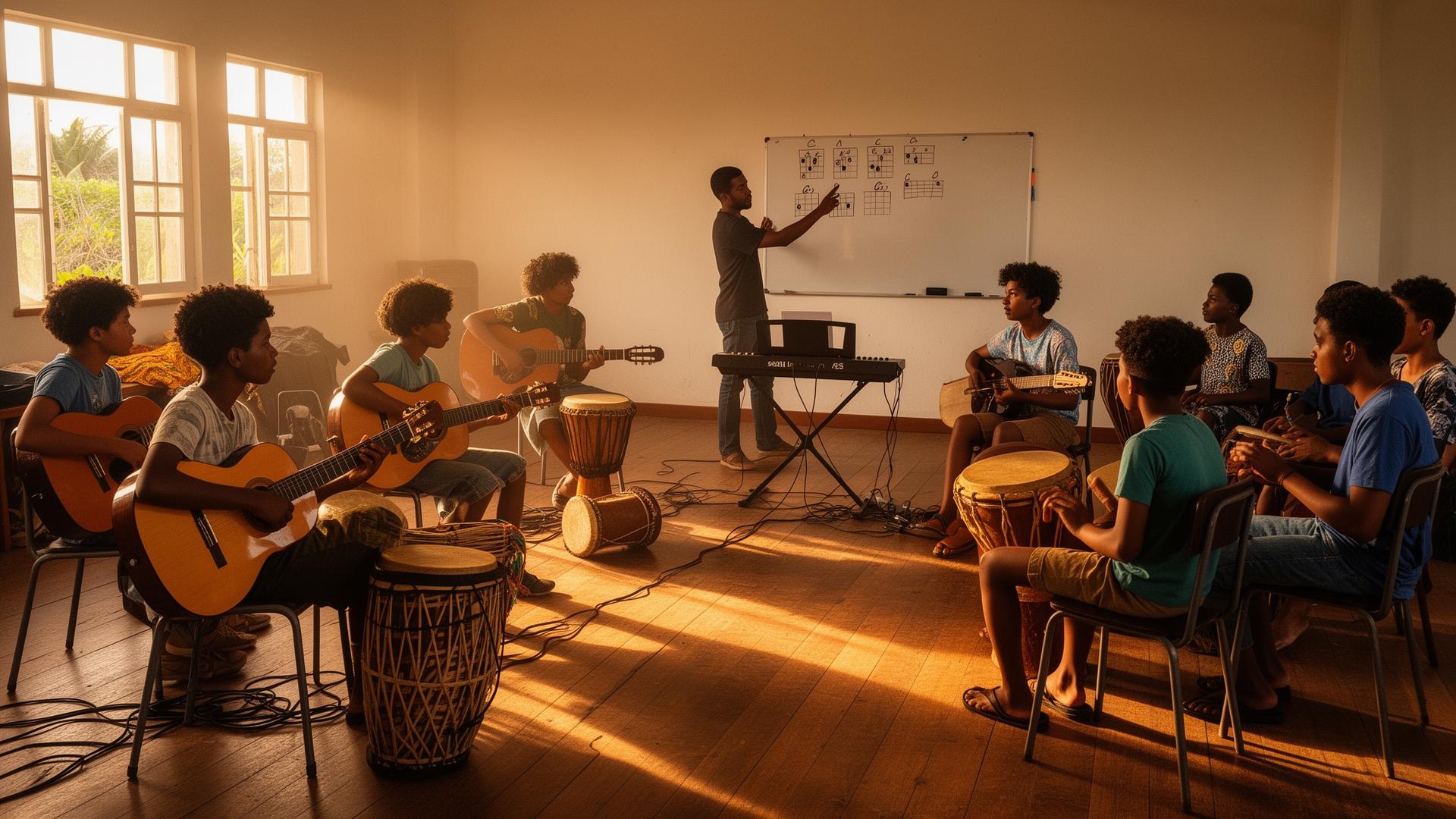
Taught by who you'll watch on Day 7

The mentor at the whiteboard today is the artist on stage at the closing concert. The fastest way to understand a musician is to take a one-hour lesson from them.

Take-home material

Every workshop ships a one-page PDF cheat sheet, a recommended practice routine and a 30-day follow-up plan — published on NOUZIK before the day ends.

On stage today

Featured artists.

  • Stacy Laville
    Vocals 101 — jazz vocals
  • Damien Pontil
    First chords on guitar
  • Mélanie Amboule
    Piano keyboard demystified
  • Salem
    Ravanne & traditional percussion
  • Rémi Beaugendre
    Hand-percussion fundamentals
  • Jamel
    Song-form & ear training
  • Félicia & Théo
    Harmony lab
Voices of the day

Speakers & mentors.

  • Conservatoire de Musique de Maurice
    Host venue & faculty partner

    Opening rehearsal studios, instruments and faculty support for the day.

  • NOUZIK education team
    Documentation & follow-up

    Filming the cheat sheets, publishing each workshop as a free recap on the platform within 24 hours.

Quick tutorials

Take this home. Try it tonight.

Compact, step-by-step walk-throughs distilled from today's sessions.

Tune your guitar by ear in 60 seconds

  1. 01Get the low E from a reference (a tuner app, a piano, or a friend).
  2. 02Press the 5th fret of the low E — that's an A. Match the open A string to it.
  3. 03Repeat: 5th fret of A = D, 5th fret of D = G. The G to B step uses the 4th fret instead.
  4. 04Finally, 5th fret of B = high E. Strum a G chord — if it sings, you're in tune.

Hold the séga tipik 6/8 pulse on ravanne

  1. 01Sit, drum between your knees, skin facing you, dominant hand on the lower edge.
  2. 02Count out loud: 'doub-doub-dab, doub-doub-dab' — two big beats, three small pulses each.
  3. 03Bass tone (palm in centre) on every 'dab'. Open tone (fingers on edge) on every 'doub'.
  4. 04Keep the count for one full minute without speeding up. That's the foundation.

Sing a clean note without straining

  1. 01Stand tall, shoulders down. Breathe into the belly, not the chest.
  2. 02Hum a comfortable pitch with lips closed — feel the buzz on your lips, not your throat.
  3. 03Open the hum into an 'ah' on the same pitch. If your throat tightens, drop the pitch.
  4. 04Do this for 5 minutes before any song, every day. Your voice will thank you in a week.

Write a verse-chorus hook in 4 chords

  1. 01Pick four chords: G, D, Em, C. Play each one for a full bar, in that order.
  2. 02Mumble any melody over the loop — no words, just sound. Record it on your phone.
  3. 03Find the two bars that feel like the chorus. Add the loudest, simplest words there.
  4. 04The other two bars are the verse. Write the story; the chorus already has the feeling.
Resources

Keep going after the room empties.

Glossary

The words you heard today.

Pitch
How high or low a sound is, determined by the frequency of vibration. Double the frequency = one octave higher.
Octave
The interval between one note and the next note of the same name — the higher note vibrates at exactly double the lower one's frequency.
Scale
An ordered set of pitches a piece of music draws from. The major scale follows the pattern whole-whole-half-whole-whole-whole-half.
Scale degree
The numbered role of a note within a scale. The 1st (tonic) is home; the 5th (dominant) pulls back home; the 4th is the subdominant. Same numbers work in any key.
Sega Tipik
The traditional, oldest form of Mauritian sega — built on ravanne, maravanne and triangle, sung in Kreol, in compound 6/8 time. UNESCO-listed since 2014.
6/8 time
A compound, ternary time signature: two big beats per bar, each divided into three. Gives sega its rocking, swaying feel — 'doub-doub-dab, doub-doub-dab'.
Pulse / beat
The steady underlying rhythmic heartbeat of a piece, and one unit of that pulse — the thing your foot taps to almost automatically.
Subdivision
Splitting a main beat into smaller, faster rhythmic units (eighths, sixteenths, triplets).
Syncopation
Rhythmic emphasis placed where the ear does not expect it, creating forward-leaning tension. The 'lift' in sega and seggae.
Polyrhythm
Two or more different rhythmic groupings happening at the same time — e.g. a pulse in groups of two against a pulse in groups of three. Underlies African, Malagasy and Afro-Creole percussion, sega included.
Ravanne
Large frame drum with a goatskin head, traditionally heated over a fire to tighten the skin. Traditionally played in a three-drum role system: piker (highest, lead patterns), middle (locked groove), bass (downbeat anchor).
Maravanne
Hand-shaken rattle filled with seeds. Adds the washing, tidal texture between the ravannes.
Triangle
Simple metal triangle providing the bright metallic accent that cuts through sega's percussion bed.
Chord
Three or more notes played together. Major chords sound bright / resolved; minor chords sound warmer / sadder. The I, IV and V chords are the 'primary' chords of any key.
Bar
One repeating unit of the rhythmic count. Pop songs are usually built in 4-bar and 8-bar groups.
Verse / Chorus / Bridge
The three most common song sections. Verse tells the story, chorus repeats the hook, bridge breaks the pattern before the final chorus.
Head voice / Chest voice
Two main vocal registers. Chest voice is your speaking range; head voice is the lighter, higher register. The smooth join between them is called the 'mix'.
Projection vs mic technique
Unamplified sega demanded real vocal projection from breath support — never throat strain. With a microphone, you 'work the mic': closer for intimate passages, slightly back for powerful ones, away from popping consonants (p, b).
Call and response
A leader sings or plays a phrase, the group answers. The oldest teaching method in Mauritian musical tradition and the foundation of most African-rooted musics.
Ear training
Learning to recognise pitches, intervals and chord qualities by ear — the single most under-trained musician skill.
"You don't need a stage to start playing. You need a chord, a breath and ten honest minutes a day."
Music Week Mauritius · Workshops Day