Music WeekMauritius 2026
Day 4Wednesday · 18 June 2026

Career, Law, Money & IP

The unglamorous half of a music career — career strategy, contracts, royalties, tax, publishing, distribution, marketing, AI and intellectual-property management. Today we read the small print.

Discipline
Industry · Business
Focus
Legal · Financial · IP
Outcome
Career-ready toolkit
Streaming
Live on NOUZIK
Today's narrative

The story of Day 4.

Day 4 is the day the festival stops being a stage and starts being a workshop on how to survive as an artist. Every session today is built around one question: "what do I, as a Mauritian musician, actually need to know, sign, file or own — and what am I losing right now by not knowing?"

The morning is law and money. We walk through the structure of a recording contract clause by clause. We look at what MASA and the local collecting society actually do for you, what split sheets are, how mechanical and performance royalties differ, and how to register your works so you stop leaving money on the table. A registered tax advisor walks through self-employed declarations, VAT thresholds, and the basics of invoicing a foreign client without losing 40% to friction.

The afternoon is the modern career. Publishing, distribution and the streaming economy — what a distributor like NOUZIK does for you, what it doesn't, and where the money actually comes from. Marketing on a Mauritian budget. Then the big one: AI, intellectual property, sampling traditional material, and the new copyright questions no law currently answers cleanly. The day closes with a working-musician panel that does not pretend the business is easy.

Full Schedule

From morning workshops to the late-night set.

  1. 09:00

    From hobbyist to professional — a career roadmap

    Caudan Arts Centre · Talk Hall

    The honest 5-year plan: building a catalogue, registering as self-employed, choosing whether to sign or stay independent.

  2. 10:30

    Reading a recording contract

    Caudan Arts Centre · Talk Hall

    Term, territory, ownership of masters, advance vs recoupment, exit clauses. Clause-by-clause, with a real (anonymised) contract on screen.

  3. 12:00

    Royalties, collecting societies & split sheets

    Caudan Arts Centre · Talk Hall

    MASA, performance vs mechanical royalties, neighbouring rights, and how to fill a split sheet so co-writers don't end up in court.

  4. 13:30

    Tax, invoicing & the freelance artist

    Caudan Arts Centre · Workshop Room

    Income tax for self-employed musicians in Mauritius, VAT thresholds, invoicing foreign clients, deductible expenses. With a registered accountant.

  5. 15:00

    Publishing & distribution today

    Caudan Arts Centre · Talk Hall

    What a publisher does, what a distributor does, and how the streaming royalty pool actually pays out. Live walkthrough of a NOUZIK release.

  6. 16:30

    Marketing on a Mauritian budget

    Caudan Arts Centre · Talk Hall

    EPK, press photos, release rollouts, paid vs organic social, mailing lists. What works for an Indian-Ocean artist in 2026.

  7. 18:00

    AI & intellectual property — the new questions

    Caudan Arts Centre · Talk Hall

    Training data, voice modelling, AI co-writing credit, sampling traditional material with consent. Where the law is — and isn't.

  8. 20:00

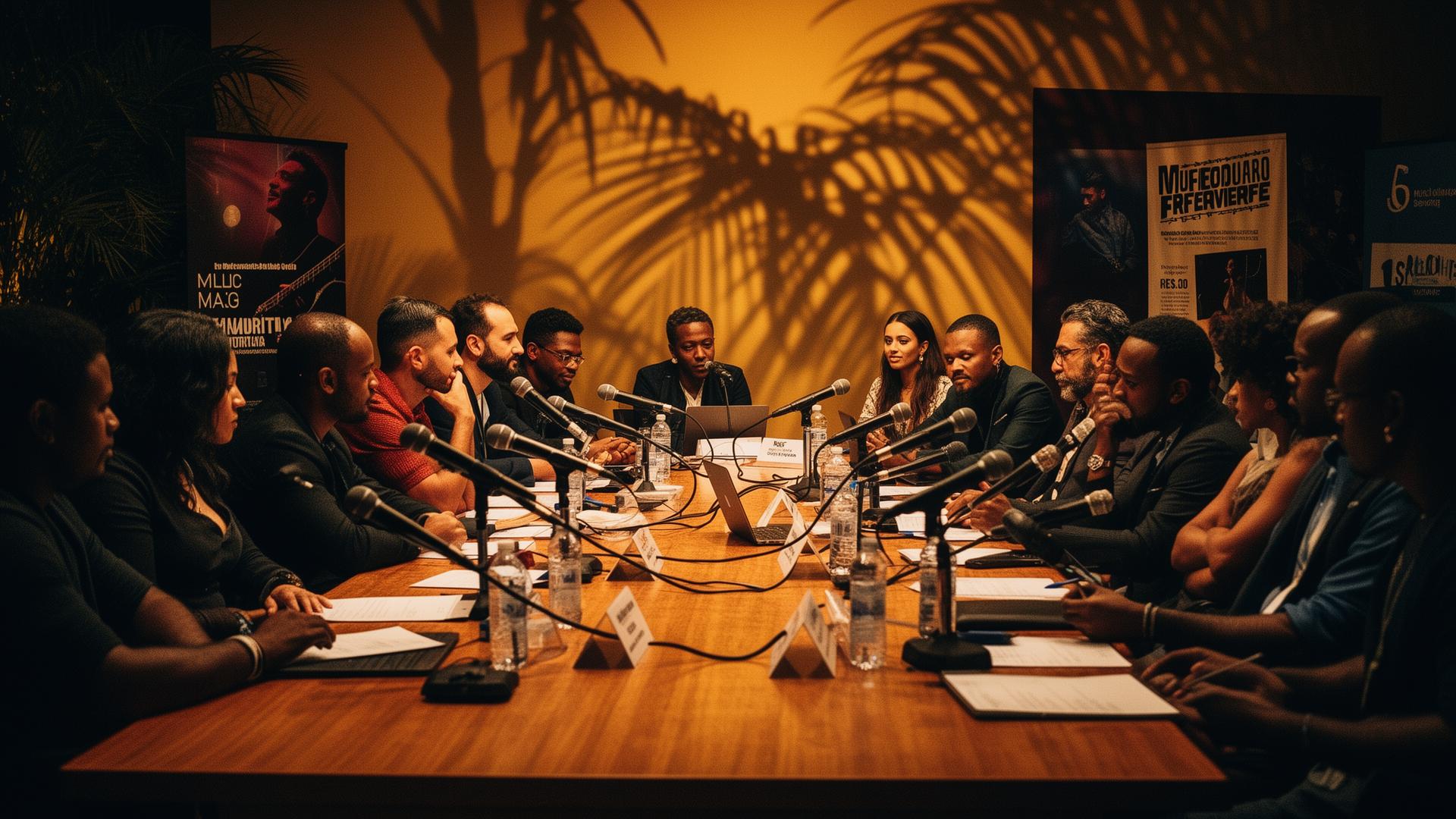
    Working Musician Panel · "What I wish I'd known"

    Caudan Arts Centre · Main Hall

    Showcase artists, a music lawyer, an accountant and a distributor — open Q&A, no rehearsed answers. Broadcast live on NOUZIK.

Contracts you can read alone

By the end of today you should be able to open a recording or publishing contract and flag the five clauses that matter most before sending it to a lawyer.
Money you're already owed

Most independent Mauritian artists are not collecting all the royalties their songs already generate. Today we walk through every register you should be on.

Your IP, on purpose

Who owns the master? Who owns the composition? Who owns the AI-generated version of your voice? You leave today with answers for the first two, and questions you can actually argue on the third.

On stage today

Featured artists.

  • BerTz
    Producer panellist · AI & IP session
  • Stacy Laville
    Working-musician panel
  • Mélanie Amboule
    Working-musician panel
  • Jean Eric Mahomet
    Working-musician panel
Voices of the day

Speakers & mentors.

  • Music lawyer (MUR Bar)
    Contracts, IP, AI

    Walks the room through a real recording contract and the current grey zone around AI training data and voice modelling.

  • MRA-registered accountant
    Tax & freelance finance

    Self-employment registration, VAT, invoicing foreign clients, allowable deductions for working musicians.

  • MASA representative
    Collecting society

    How royalty collection actually works in Mauritius — registration, declaration, payout cycle.

  • NOUZIK distribution team
    Publishing & release strategy

    Walks through a real release from upload to first payout, with the dashboard on screen.

Quick tutorials

Take this home. Try it tonight.

Compact, step-by-step walk-throughs distilled from today's sessions.

Register a song properly (before you release it)

  1. 01Fill a split sheet: every co-writer, producer and topliner, with their percentage. Everyone signs.
  2. 02Register the composition with your local collecting society (MASA in Mauritius).
  3. 03Register the recording (the 'master') separately — it's a different right, often a different owner.
  4. 04Get an ISRC code for the recording and an ISWC code for the composition through your distributor or society.
  5. 05Keep one PDF folder per song: split sheet, registrations, contracts, stems. You'll thank yourself in five years.

Read a recording contract in 10 minutes

  1. 01Find the Term clause — how long are you locked in? Look for option periods that extend it automatically.
  2. 02Find the Territory clause — worldwide, or limited? Mauritius-only deals exist.
  3. 03Find Ownership of Masters — do you own them, do they revert to you, or do they belong to the label forever?
  4. 04Find the Advance & Recoupment clause — what's paid up-front, and what does the label need to recoup before you see royalties?
  5. 05Find the Exit / Termination clause — can you leave if they don't release the record? Under what conditions?
  6. 06If any of those five answers worry you, do not sign. Take it to a music lawyer.

Run a release on a small budget

  1. 01Lock the final master 6 weeks before release. Earlier is better.
  2. 02Upload to your distributor 4 weeks before — that's the minimum for editorial playlist pitching.
  3. 03Press photos + a one-page EPK ready 3 weeks out. Quote, bio, contact, hi-res photo.
  4. 04Two weeks out: announce on socials with the cover art and a pre-save link. Email your list.
  5. 05Release day: one post per platform, one to the mailing list, one to local press. Don't burn yourself out.
  6. 06Week +1: share listener reactions. Week +2: behind-the-scenes / lyric video. Keep feeding the algorithm.

Use AI without losing your rights

  1. 01Read the terms of any AI tool you use — some claim ownership of the outputs, some don't.
  2. 02Never train a voice model on someone else's voice without written consent. Including a deceased artist.
  3. 03If AI helped you write, document the human contribution clearly — current copyright law protects only human authorship.
  4. 04If you sample traditional / heritage material, credit the source community and discuss revenue sharing in writing.
  5. 05Keep an audit trail: prompts, dates, tool version. Disputes are won with receipts.
Resources

Keep going after the room empties.

Glossary

The words you heard today.

Master
The actual recording of a song. Whoever owns the master controls how that recording is used and earns money from it.
Composition (Publishing)
The underlying song — melody and lyrics — separate from any specific recording. Generates publishing royalties.
Two copyrights per release
Every recorded song carries two distinct copyrights: one in the composition (the song itself) and one in the master (the specific recording). They can be owned, licensed and earned-on separately.
Mechanical royalties
Money paid every time a composition is reproduced (sold, streamed, downloaded). Paid to the songwriter / publisher.
Performance royalties
Money paid every time a composition is played publicly — radio, venue, stream. Collected in Mauritius by MASA, and internationally via reciprocal agreements with sister societies.
Neighbouring rights
Royalties paid to performers and master-owners (not just songwriters) when the recording is broadcast or played publicly.
MASA
Mauritius Society of Authors — the local collecting society. Where you register your works to collect performance and mechanical royalties in Mauritius.
Split sheet
Written agreement signed by everyone who contributed to a song, stating each person's ownership percentage. Should exist before release — not after a dispute.
ISRC
International Standard Recording Code — a unique ID for a specific recording. Required for streaming distribution and royalty tracking.
ISWC
International Standard Musical Work Code — a unique ID for a composition. Issued by collecting societies.
Advance
Up-front money paid by a label or publisher. Almost always recoupable — you don't earn royalties until they make that money back from sales / streams.
Recoupment
The process by which a label / publisher recovers the advance from your royalties before paying you any further.
Music publisher
An entity that administers and exploits a composition's copyright on the writer's behalf — registers it, collects royalties, pitches syncs and covers.
Digital distributor
A service that delivers your finished recording onto streaming and download platforms. Examples: NOUZIK (regional), DistroKid, TuneCore.
EPK (Electronic Press Kit)
One organised package — usually a webpage or PDF — with a concise bio, high-quality photos, 2–3 music links, key past performances and current contact info. The single page every booker actually opens.
Sync licence
Permission to use music in visual media (film, TV, ad, game). Often the highest-value single payment in a working musician's year.
Editorial vs algorithmic placement
Two paths into streaming playlists. Editorial = a platform's human curators (requires advance submission via your distributor). Algorithmic = follows naturally from strong early engagement (saves, replays, follows).
BRN (Business Registration Number)
Identifier issued by the Corporate and Business Registration Department when registering as self-employed in Mauritius — the first administrative step for invoicing legitimately.
CSG (Contribution Sociale Généralisée)
Mauritian social contribution that applies to the self-employed once registered. Rates and thresholds change — confirm current rules with the MRA.
VAT
Value Added Tax. In Mauritius, registration is required above the current turnover threshold (recently MUR 6m). Below it, you don't charge or file VAT — confirm current threshold with the MRA.
Trademark (artist name)
An artist or band name functions like a small-business brand. For emerging artists the priority is checking the name isn't already in active use; formal trademark registration can come later.
Generative AI (in music)
Tools that create new audio (vocals, instruments, full tracks) from text or audio prompts. Current law treats output authorship case-by-case.
Voice cloning
AI-generated imitation of a specific voice. Requires explicit consent — including for deceased artists. Treat as a hard boundary, not a grey area.
Fair use / fair dealing
Narrow exceptions that allow limited use of copyrighted material without permission (criticism, parody, education). Not a blanket licence to sample.
"The contract you don't read is the contract that ends your career. Read it. Twice. Then call a lawyer."
Music Week Mauritius · Career & IP Day